Sam Taylor-Johnson’s Portraits, Creative Instincts and the Bananas That Connected Them
In a new photo book, Sam Taylor-Johnson traces decades of portraiture, creative risk and friendship with Michael Stipe.
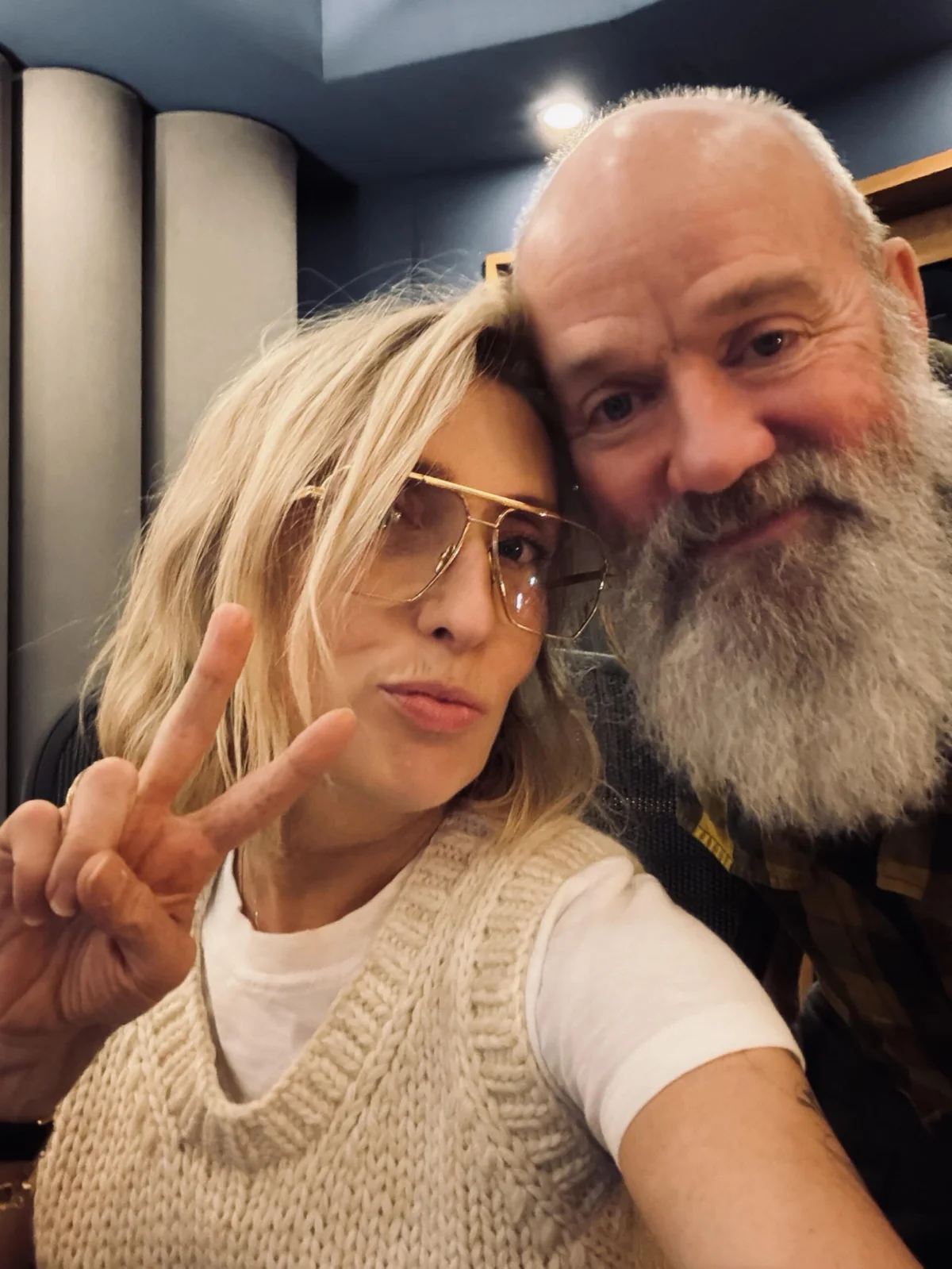

Sam Taylor-Johnson and Michael Stipe, courtesy of Sam Taylor-Johnson.
A portrait can hold a whole relationship in a flash of light. For Sam Taylor-Johnson, one such image of Michael Stipe brings their friendship back to its beginning: when they met backstage at the 2005 Live 8 concert, he wore a stripe of blue paint across his face. Nearly two decades later, she photographed him in a church in Saint-Paul-de-Vence, France, where blue light from stained glass fell across him again. The echo is striking, but the picture also stands on its own—a chance arrangement of person, place and light.
The photograph appears in The Self and The Portrait, Taylor-Johnson’s first photo book, published by Rizzoli. With more than 200 images from across her career, the collection moves between formal portraiture and a closer study of what happens when a famous person is simply a person in front of the camera. It includes Crying Men, her series of actors weeping, alongside portraits of David Hockney, Miuccia Prada and Courtney Love. The images ask how identity and public persona can coexist, and what becomes visible when a subject lets the performance drop.
Taylor-Johnson and Stipe met at New York’s Electric Lady Studios to talk about the book and She Was I, an exhibition opening October 22 at Jackson Fine Art in Atlanta. Their conversation kept circling back to the practice behind the pictures: film’s physical limits, the usefulness of chance, the difficulty of writing and the freedom that can follow a major change in family life. And, improbably, bananas.
Film’s limits sharpen the eye
Preparing the book brought Taylor-Johnson back to her archive in two very different forms. Working through film meant opening boxes of prints, contact sheets and negatives. She remembers the process as joyful and clarifying. Finding images among tens of thousands of digital files, by comparison, felt like a chore. That difference made her think again about film as a material process, with a pace and chemistry that digital photography doesn’t reproduce.

Sam Taylor-Johnson: The Self and the Portrait (Rizzoli)
Stipe points to the discipline built into film: a roll of large- or medium-format film offers 12 frames. Digital shooting can invite a photographer to make many versions and choose the keeper later. Taylor-Johnson learned on film, and says that limited supply forced her to develop her eye quickly. She couldn’t afford endless rolls or processing, so she had to work out composition and make the picture in one or two frames.
That kind of pressure matters in portraiture, where a person’s patience and attention are part of the picture. Taylor-Johnson and Stipe return to the idea of a decisive moment: the instant when light, gesture and a subject’s presence line up. The film camera makes each exposure feel like a choice. Digital tools offer more room to search, but, in Taylor-Johnson’s account, that can also delay the act of seeing. Her archive’s return to film is less a rejection of digital photography than a reminder of what a limit can teach.

Sam Taylor-Johnson, Escape Artist (Multicoloured), 2008, Courtesy Sam Taylor-Johnson
A bunch of bananas, in and out of the frame
The pair’s most unlikely shared subject began in a Berlin café. Taylor-Johnson spotted a string holding a large bunch of bananas and loved the way it looked. Stipe went back to photograph it more than once because she wasn’t satisfied with the first pictures. He made more images over several months and sent them to her, intending for them to become part of her hanging pictures. The bananas didn’t make it into the book, but one did appear in her Wired series, in which she hangs from cranes in Joshua Tree.
For Taylor-Johnson, the fruit’s appeal lies partly in the mismatch between its ordinariness and the feeling it carries. She calls it an image that can mean nothing and everything. The bananas also became a running joke with a less charming turn: after making the photographs, Stipe discovered he was allergic to them. He told Taylor-Johnson that his throat closed during a flight. He had already known he was allergic to latex, and said he learned that banana and avocado allergies can occur alongside it. The conversation veers from art to an uncomfortable surprise, then back again to the image that started it.
Light, memory and the portrait subject
Stipe’s portrait in the book brings the discussion back to their first meeting. At the church in Saint-Paul-de-Vence, the light crossing his face recalled that blue stripe from 2005, though this time the colour came from the stained glass. Taylor-Johnson describes the moment as almost spiritual. Stipe jokes that he looks like “the saint of light,” then offers a more personal measure of the picture: he likes how it renders his ears. A slight change in angle, he says, can make them look strange; here, they feel proportionate to his head and face.

Sam Taylor-Johnson, Michael Stipe, Saint-Paul-de-Vence, 2024, Courtesy Sam Taylor-Johnson
That exchange gets at the intimacy of Taylor-Johnson’s portraiture. The person behind the image has a say in what feels true about it; the photographer brings her own attention to timing, composition and mood. Their friendship gives them a long history to draw on, yet the photograph depends on a single present-tense event: Stipe standing in a particular room as light moves across him.
They describe their creative work as spanning several forms. Stipe makes music, art, photographs and writing. Taylor-Johnson, whose attention is currently on photography, is also writing—something she says she hasn’t done before, even though she has always told stories. Film, art and photography share the demand to recognize a moment and act on it. Writing asks for another sort of patience. It can feel infuriating, she says, before opening into a flow that seems to arrive from somewhere beyond deliberate control.
Stipe offers the familiar phrase “write drunk, edit sober,” then clarifies the point: write with abandon, without interrupting each thought to judge it. Taylor-Johnson agrees. She sometimes rereads her own work and wonders who wrote it. The material may come from experience and memory, but a separate voice can emerge when she is present enough to follow it. The same attention to presence that helps her make a portrait can, in a different form, help her find a line of writing.

Sam Taylor-Johnson, Fuck Suck Spank Wank, 1993, Courtesy Sam Taylor-Johnson
Making work through change
For Taylor-Johnson, the book and exhibition arrive as her family life shifts. She has been a hands-on parent to four children for 29 years. Now that they are older, at school or working, she finds herself with time she hasn’t had before. Her first reaction was grief: she joked that her children had made her redundant, as if she had been fired. Then came freedom. A trip to New York without the children gave her room to move through the city without a set plan, at the same time that the book and Atlanta exhibition were taking shape.
She describes the change as an opening, not a neat resolution. The feeling of loss and the sense of possibility arrived together. That tension resonates with the way she talks about creative work: one form may recede while another starts to come into focus. Photography is at the front of her mind now; writing is becoming a new practice. The exhibition, too, reflects the book while giving the images another setting.
Fame at human scale
Asked about her interest in photographing well-known people, Taylor-Johnson says she is drawn to figures at the height of their creativity. In Crying Men, made more than 20 years ago, she wanted to consider male vulnerability through what she calls the female gaze, bringing the stature of fame down to a human level. The idea felt unfamiliar to some viewers at the time, she says; the conversation around men’s vulnerability has since changed.

Sam Taylor-Johnson, Crying Men (Laurence Fishburne), 2002, Courtesy Sam Taylor-Johnson
The series depends on a question viewers can’t always answer: are these actors performing, or are they crying as themselves? Taylor-Johnson says she knows the stories behind most of the images, but made a promise to each subject not to reveal them. Some actors were happy to use a tear stick. One arrived already crying, relieved not to have to sit smiling and pretend to be someone else. Taylor-Johnson hadn’t loaded film into her camera yet, a small moment that became a lesson in preparation.
She hadn’t initially grasped how exposed the request could feel. These actors had no character or narrative to lean on; she was asking them to cry as themselves. Steve Buscemi, feeling happy on a sunny day, didn’t want to. Making the series took three years. Taylor-Johnson says she had been through a serious period of illness, and that the work became a way of processing it, as though the subjects were moving through grief on her behalf. It didn’t resolve everything she hoped it would, she says, though it resulted in a strong body of work. Stipe suggests “catharsis” as a word for the experience.

Courtney Love, 2004, Courtesy Sam Taylor-Johnson
Women artists, different industries
The book also includes writing by two friends: photographer Lynsey Addario and artist Tracey Emin. Emin wrote about their friendship and Taylor-Johnson’s practice from her own perspective, an account Taylor-Johnson describes as a gift. The group’s history reaches back to the Young British Artists, where Taylor-Johnson, Emin and Sarah Lucas shared a sense of being women artists making space for their work.
Taylor-Johnson recalls the art world as a place where a band of women artists could emerge together. Film felt different. She describes entering that industry as one of very few women in a room, and its expectations struck her as old-fashioned compared with the art world. The contrast sharpened her sense of how much the structure of a field shapes an artist’s experience.

Sam Taylor-Johnson, Tracey Emin, 2012, Courtesy Sam Taylor-Johnson
Her move into feature films brought a different kind of risk. Stipe brings up Fifty Shades of Grey; Taylor-Johnson says she hadn’t even read the book before taking on the project. She connects her lack of fear on set to having faced serious illness: walking into a hospital was frightening, while joining a crew and figuring out what to make together felt manageable. It’s a candid account of how experience can reset the scale of professional uncertainty.
Their collaboration on Stipe’s music videos offers a more personal meeting point between their practices. Taylor-Johnson directed “Überlin” and “Your Capricious Soul.” Stipe places both among his strongest videos, praising the humanity and energy they carry for viewers who don’t know the history between them. Taylor-Johnson agrees that they should work together again. Stipe has ideas, and new music is in the works.
That next project feels like a fitting continuation of the book’s central interest: the moment when a connection becomes visible. Sometimes it arrives through a face caught in stained-glass light; sometimes through a film frame, a written line or an unlikely bunch of bananas. For Taylor-Johnson and Stipe, the useful question is less what a subject is supposed to mean than what happens when they pay close attention.
The post Sam Taylor-Johnson and Michael Stipe Can’t Stop Photographing Bananas appeared first on Interview Magazine.