FlucT Returns With a Sensory, Body-Conscious Performance at OCDChinatown
After five years away, Monica Mirabile and Sigrid Lauren revisit FlucT through live performance, video and sculpture that probe care, power and distorted perception.
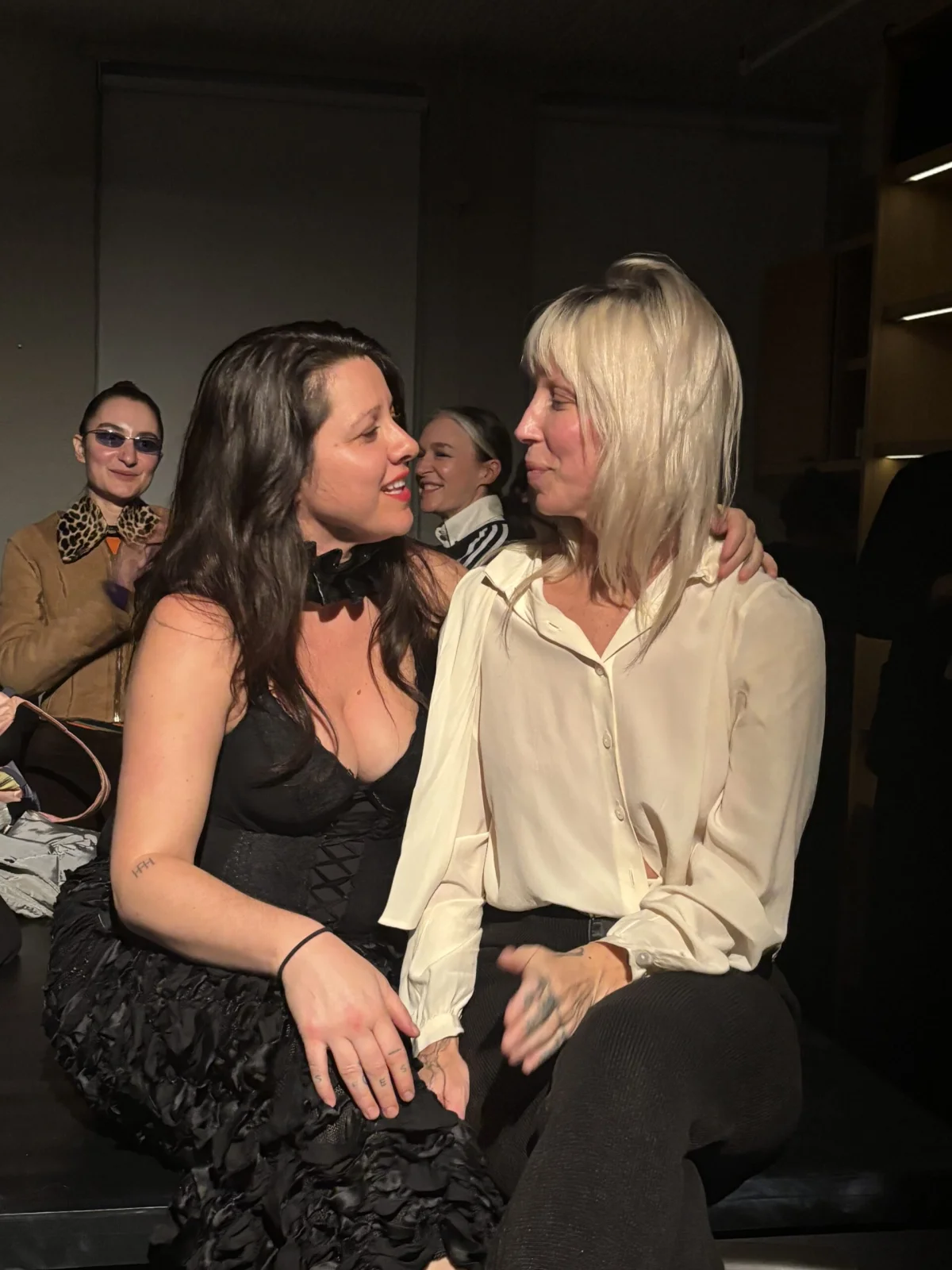

Monica Mirabile and Sigrid Lauren. Photos courtesy of Whitney Mallett.
FlucT’s return turns the audience’s body into part of the work. At Tough on the Tongue, Monica Mirabile and Sigrid Lauren build a world of live dance, sculpture and video that asks what happens when looking becomes participation. Visitors climb stairs to OCDChinatown’s loft near Canal Street, then encounter performers on a countertop, four dancers moving in a shower, and videos that can only be viewed by getting low to the ground. The experience is deliberately physical and disorienting. It puts the act of watching under scrutiny.
The show marks the duo’s return after a five-year performance hiatus. Their collaboration spans nearly 15 years, and the break gave them room to reconsider what FlucT asks of them and of each other. The work grew from a close relationship into a demanding professional undertaking, with deadlines and administrative responsibilities crowding out the care and attention that had once sustained it. For this revival, the pair looked back through their archives, then began teaching older choreography to performers who could carry it forward in their own bodies.
That shift gives Tough on the Tongue its emotional charge. The performers resemble younger versions of Mirabile and Lauren, but they aren’t replicas in any simple sense. The duo has changed physically and artistically; their understanding of risk has changed, too. The piece lets them revisit their history while making room for the bodies and perspectives of the dancers performing it now.
A return shaped by distance
Mirabile and Lauren said the work of preparing the show left little time to pause after opening night. For Lauren, the scale of that effort brought relief: they had been working day and night for weeks. The return began with looking through FlucT’s past performances. That archive was exciting, funny and emotionally difficult, and it helped the artists imagine choreographing other people rather than stepping into every work themselves.
Their partnership has carried more than one kind of intimacy. They once nearly married and have matching “paradise” tattoos on their ring fingers. FlucT began as a passion project, then developed into a job that could occupy their full working lives. As the project grew, so did the less visible labor: planning performances, meeting deadlines and handling the practical work of being artists. They became business partners, and the relationship between the two women began to suffer under the pace.
That strain mattered artistically. Lauren described the work’s purpose as engaging with power, care and support in a way that felt real to them. Mirabile said the project’s richest material comes from their relationship: reflecting the culture around them while supporting one another physically, emotionally and intellectually. When deadlines took over, that exchange was diminished. Continuing to accept work without addressing the toll risked leaving both the friendship and the performance hollow.

Returning to old material also meant confronting what their earlier choreography demanded of a body. Lauren warned performers against movements she herself once did, including dropping from a shoulder stand onto a hip. She now lives with ongoing physical issues that require attention. With more awareness of those costs, the pair could adapt the choreography and ask dancers to perform it with greater care.
Seeing the work performed by two younger women was, for Lauren, almost psychedelic. At one point she wondered aloud whether she and Mirabile should join in behind them. Mirabile found the first rehearsal especially moving: watching someone else inhabit choreography that had grown from a shared outlook and similar backgrounds made their history visible in another person. They could explain what certain moments meant to them, then watch the dancers connect those ideas to their own experience.
The opening-night performance on the countertop combined highlights from three earlier works. Its placement was shaped by the space: the performers were elevated about three feet above the floor, so the choreography had to suit the platform as well as draw on the archive. Site-specific decisions like this run through the show. Each room changes how a visitor can approach the work, and how the work can approach them.
Four bodies, four phases
In a walk-in shower, four performers stand apart from one another, each moving through a simple repeated gesture. They represent the four phases of the menstrual cycle: luteal, follicular, ovulation and menstruation. Lauren and Mirabile said the installation connects those internal shifts to the way a person can understand herself differently from one moment to the next. Mirabile described the period after menstruation as a time when someone may feel capable of taking on anything, only to later look back at a difficult stretch of anxiety or low mood and feel far removed from it.
The work holds that internal experience alongside the viewer’s gaze. The performers appear nude in a bathroom setting, and what a visitor sees can become distinct from what the work means to them. The artists recalled one man standing in the space for around 30 minutes; Lauren became uneasy and Mirabile approached him. The scene makes the difference between observing and participating difficult to ignore, especially in a room where people have phones and the performers are exposed to being watched.
The show’s interest in bodily perception also sits within FlucT’s longer engagement with violence and care. Earlier coverage described the duo’s work through rape culture, a subject they said remains embedded in the performances. Mirabile explained that violence in their choreography isn’t directed at one another. It gives form to violence they see in the world and to the experience of growing up in a culture where sexual violence shapes everyday life.

For Tough on the Tongue, the body becomes a way to test how much control a viewer has over what they see and how they respond. The video installations require visitors to crawl on their hands and knees or lie beneath a large foot. Lauren described the arrangement as an invitation to become an active participant: to get more information, visitors must choose a vulnerable position. The pressure of lying under the foot adds a physical sensation to the work’s questions about information arriving without consent.
Looking, scrolling and taking part
Mirabile connects the installation to scroll culture: the steady stream of material people absorb while moving through feeds. The show asks how that flow affects attention, listening and behavior. Its title points toward the difficulty of communicating and receiving information through the senses. For the artists, repeated exposure can distort perception, while the viewer’s actions become part of the cycle. Crawling toward a screen or lying beneath the foot makes that dynamic physical.
Photography sharpened the question on opening night. Interviewer Whitney Mallett recalled trying to take a picture of a performer who had turned away, then being told by someone from OCDChinatown that photography wasn’t allowed. Mallett felt both ashamed and defensive. Lauren said approved images were available. The moment echoes the show’s broader tension: the desire to see and record can meet the performer’s need for boundaries, even when the viewer believes they’re acting carefully.
There’s another loop in the work. Someone watching a visitor crawl toward a video might take a picture of that person in a vulnerable position, just as the visitor is looking at someone else. Lauren said she enjoyed watching people peer beneath the foot, noticing that the installation gave them a role rather than leaving them at a comfortable distance. The show’s rooms keep shifting the viewer between watcher and watched.
The soundtrack contributes to that unsettled feeling. Abrupt samples and changes in music interrupt the emotional rhythm of a scene. Mallett described nearly crying while watching performers eat sandwiches in slow motion, only to have a sound shift break the moment before it became sentimental. The edits don’t cancel emotion; they make it harder to settle into a single response.
Not every installation asks for solitary attention. Rocking chairs prompted conversations between visitors who didn’t know one another, while beds became social spaces. The beds refer to a period when Mirabile and Lauren shared a room in Baltimore, with two queen beds, as their relationship and performance practice were becoming deeply intertwined. The installation carries a private memory into the venue, where it can take on a social life of its own.

Past work, present bodies
The opening brought together people who had followed FlucT in its earlier years and visitors who knew the artists through their current performance communities. Some had never seen the duo perform live. That mix made the five-year break part of the event: a reunion for some, an introduction for others, and a chance to see how the work has changed.
The artists themselves moved through the space in slacks, a contrast with the more exposed bodies in the performances and video. Their presence made the installation feel less like a continuous stage show than a whole environment, with the artists watching and responding as visitors navigated it. The video, meanwhile, presents the pair in tights without underwear, a choice they discussed with humor while acknowledging how directly it exposes the body.
The video was filmed at a farmhouse owned by Liutas MvH, founder of OCDChinatown. Mirabile and Lauren said he was supportive of their ideas and encouraged them to push the space further; they asked about knocking down a wall and making holes, and he agreed. They had been expected to work together six years earlier, so his invitation to collaborate again returned after a long delay. Filming also gave Mirabile and Lauren their first chance to make new choreography together since the hiatus.
That new work felt softer to Lauren, a reflection of the time they had spent tending to their relationship over the previous five years. It suggests a different register for FlucT, with the return shaped by the care they had struggled to protect during the project’s busiest period. The artists plan to perform a new piece together in January 2027 while the installation is still open. In November and December, other dancers are set to perform a full retrospective FlucT piece.

For Mirabile and Lauren, revisiting FlucT means asking what can be carried forward and what needs to change. The archive supplies choreography and memory; the performers bring their own bodies; the installation puts viewers into the same unsettled field of looking and being looked at. The result doesn’t resolve the tensions between power and care. It gives them room to be felt, and asks visitors to notice their own part in the exchange.

Monica Mirabile and Sigrid Lauren’s Tough on the Tongue is at OCDChinatown through January 2027.