Michael M. Bilandic’s <i>Cabaret Boys</i> Brings Downtown New York to the Screen
Bilandic and Abel Ferrara talk improvised scenes, familiar New York locations, cabaret, and the creative communities behind <i>Cabaret Boys</i>.
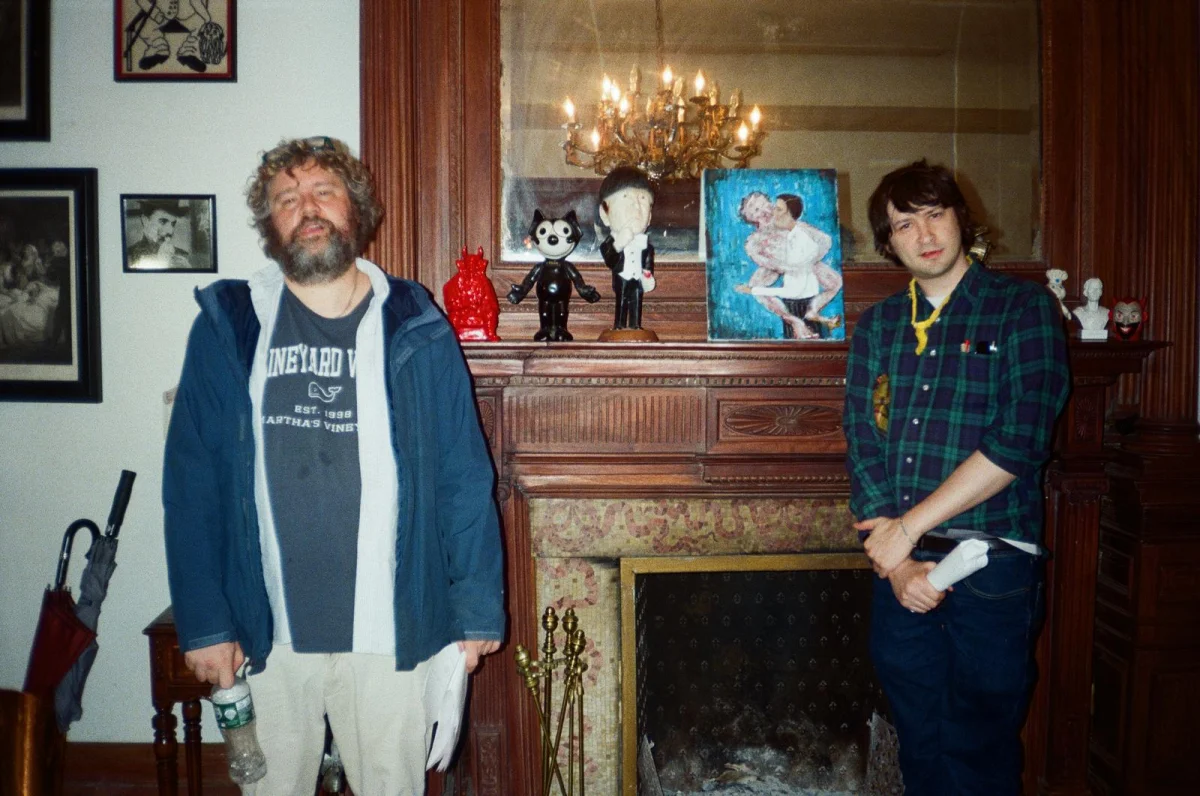

Michael M. Bilandic and Owen Kline, photographed by David Cardoza.
Michael M. Bilandic’s Cabaret Boys finds its texture in places the filmmaker already knows: KGB, Bacaro, and The Odeon. The Downtown New York rooms aren’t dressed up to look like themselves. They’re allowed to be themselves, down to the details that make a location feel inhabited. That approach suits a film about Jackman, an eccentric therapist who believes, “Everyone in the world is an artist. It’s up to me to pull that out of them.”
Played by Theodore Bouloukos, Jackman works from a lavish Manhattan home and turns his attention to young men he considers troubled or oddball, hoping to shape them into outsider artists. The plan grows less predictable when a former patient returns and is chosen to headline Jackman’s first cabaret night. At the center is a character with a peculiar theory of creativity; around him, Bilandic builds a world from friends, longtime collaborators, improvisation, and New York venues that matter to him.
The film premiered at the Downtown Festival, with screenings at The Roxy. Owen Kline collaborated on the story, and the cast also includes Talia Ryder, Miles Emanuel, Larry Clark, Dean Kissick, Andrew Norman Wilson, Adam Friedland, and Abel Ferrara, who co-stars. Ferrara spoke with Bilandic about making the film, working with familiar people and locations, and the strange economics of creative life. Their conversation also wanders, as these conversations do, through a wrestling event, a song from The Funeral, a fashion show, and cashmere season.
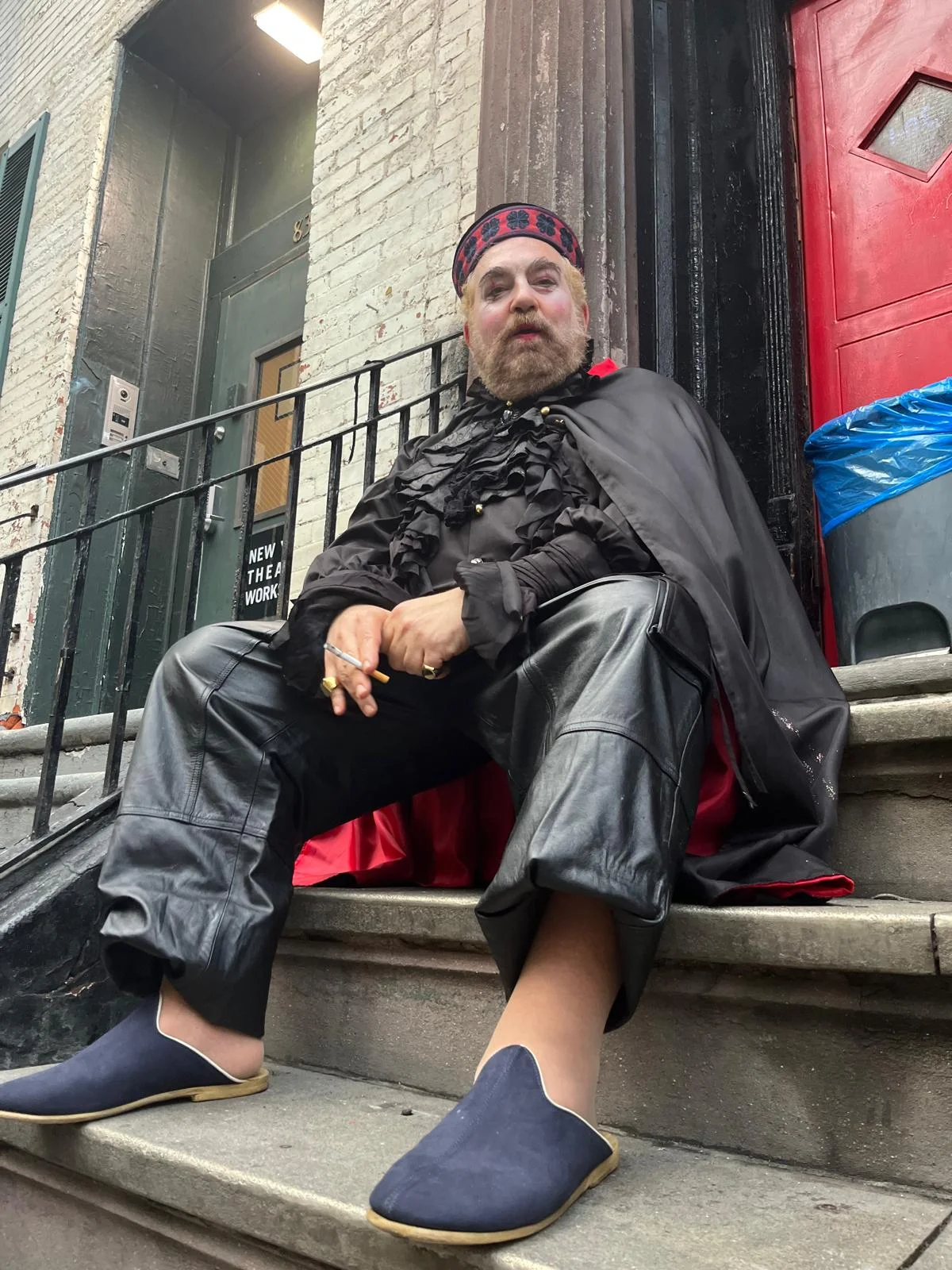
Theodore Bouloukos, photographed by Michael M. Bilandic.
Making room for the unexpected
When Bilandic and Ferrara spoke, Bilandic had just collected the film’s DCP, or Digital Cinema Package, and watched it back. He’d braced himself for a technical mishap; instead, the picture looked good. Sean Price Williams had completed the color grade, though he wouldn’t see the finished version until the premiere. Bilandic liked the idea of showing a film at a venue that also appears in it, recalling The Projectionist, which played at Cinema Village after being made there. Joe Delia was expected at the screening.
That kind of overlap between making and showing feels at home in Bilandic’s practice. A location can be a workplace, a social hub, and part of the finished film all at once. The same principle carries into the cabaret sequence: Jackman’s protégé goes to KGB to sing “Ta-ra-ra Boom-de-ay,” and Bilandic needed a pianist who could follow the scene’s unsettled rhythm. He contacted Delia only a day or two before filming. Delia agreed, saying he loved improvising along to chaos.
Ferrara understood the appeal. He recalled performing in a wrestling ring between bouts, with his friend Mike Vinas joining him. Vinas was among the people with whom Ferrara first started making films, back in their original band. Ferrara also described performing “Pet Sematary” with an Italian group in masks that made them look like wrestlers. The event’s appeal, as it was explained to him, was its fun-house structure: move from room to room, meet characters, and let the audience be startled by whatever comes next.
Bilandic called that kind of experience a possible future for film exhibition. Ferrara was game, particularly if the point was to scare the audience, but he also joked about how far the performers might push the audience’s nerves. The exchange lands on a shared interest in live, unruly encounters. Both filmmakers seem drawn to situations that can’t be fully smoothed out in advance, whether that means a cabaret pianist improvising or a crowd reacting to an unusual performance.

Owen Kline, photographed by Louis Miller.
That openness to discovery also came up when Ferrara described making The Funeral. The team had to write a song for Chris Penn’s character, and Ferrara struggled to get it right. An idea finally arrived over lunch, late enough to add pressure. Penn, who Ferrara remembered as physically imposing, insisted that the song stay as written. He brought up his mother, a painter whose work he felt she would make beautiful and then alter, and warned Ferrara not to do the same to the song. Penn sang it as it stood, and Ferrara felt the result worked.
The anecdote offers a neat counterpoint to Bilandic’s line that discovery is half the fun. Improvisation doesn’t mean every choice needs to be changed on the fly; sometimes the important instinct is knowing when a rough idea has found its shape. In a film whose cabaret performance depends on a pianist responding in the moment, that distinction matters. The scene can be loose because the people in it are paying attention.
Ferrara’s story about Penn also captures the unpredictable logistics of location filmmaking. While shooting in a Harlem club, Ferrara heard shouting outside and assumed something had happened nearby. The noise turned out to come from people reacting to a major news event. He recalled the crew trying to keep track of Penn, who could disappear from the group without warning. An older man spoke with Penn, then urged Ferrara to put him in a film. The episode sounds chaotic in retrospect; at the time, it was one more thing to manage while making a scene.
Bilandic connected that memory to the present-day habit of sharing location tracking with friends. He had made a film while that technology was becoming ordinary, but said he wouldn’t use it himself. The brief exchange draws a line between the practical demands of a production and the personal boundaries people choose to keep. Staying close to a collaborator can matter on set; keeping tabs on everyone isn’t automatically the answer.
Owen Kline, photographed by Louis Miller.
Two cameras, one lived-in room
For Bilandic, the film was an intense stretch of work. He was excited by the process, but also ready to return to writing for a while. Between his previous film and Cabaret Boys, he had written articles, a practice that gave him some of the same satisfactions as filmmaking: finding a character, developing a story, and shaping the material in the edit.
Ferrara had just finished a book and had little desire to repeat the experience. He compared returning to writing after directing to going back to a farm after seeing Paris, quoting Norman Mailer. A book, he said, becomes cinematic at the editing stage, when its pieces are revised and rearranged. Film editing has its own close attention to beats, lines, and color. For both men, the two forms share a hands-on process of deciding what stays and what needs to move.
One production choice Bilandic finally adopted was shooting with two cameras. Ferrara had recommended it years earlier, along with filming close to home, when Bilandic was making Happy Life. Bilandic joked that it had taken him fifteen years to follow the advice. The approach had one substantial effect on the edit: his first rough cut ran three and a half hours. The completed film was 90 minutes.
Ferrara’s case for two cameras is rooted in performance. When actors are improvising, he argued, repeating the same moment from another angle may be impossible. One camera can miss the response that makes a scene feel alive. The familiar objection is that two cameras limit lighting options, but Ferrara pushed back: for him, a scene can be lit as a whole environment, one that works from every direction. Williams handled lighting on Bilandic’s film, shaping the room rather than forcing it into a single preferred angle.
That thinking runs alongside Ferrara’s broader preference for locations that already have their own character. He questioned the impulse to arrive somewhere, cover its windows, replace its lights, and rearrange the room until it no longer feels like the place that attracted the filmmakers. If a location is worth choosing, he suggested, its existing qualities should be part of the visual plan. Bilandic’s budget made that practical, but the result also suited his taste: the film uses spaces he and his collaborators know, including all three floors of KGB and a restaurant Ferrara visited with him.

Abel Ferrara, photographed by David Cardoza.
Ferrara recalled how a location’s rough edges can be precisely what make it useful. A room he filmed in had old fluorescent fixtures, some missing, which gave it a particular feel. Before he could ask the crew to leave them as they were, new fixtures had been installed. He arrived to find that the feature he liked had vanished. The story is funny, but it also gets at a common set tension: a production may instinctively tidy a space, while the director is drawn to its wear and irregularity.
At another point, Ferrara described filming inside a prison for Welcome to New York, using guards alongside actors. His comparison between actual people and screen portrayals turned into a broader observation about performance: people absorb what they see in popular culture, and then sometimes imitate it. Bilandic agreed that life and screen images influence one another. For filmmakers, that can be a complication when a person has learned how a role is “supposed” to look. Ferrara’s direction was simple: he wanted people to behave naturally within the scene.
Ferrara and Bilandic’s shared interest in real locations extends to the street life that often gets scrubbed from polished productions. Ferrara said that when he watches his own films, he looks at their edges: a building, a car, or someone passing through the background. He remembers New York films from the 1980s for the repeated faces among their background performers, and he praised the chance details in Taxi Driver and Bad Lieutenant. In the latter, Bilandic pointed to a final shot that leaves a casino sign and unplanned street activity in view.
For the two directors, those details give a scene a sense of being surrounded by a city rather than staged apart from it. Ferrara remembered a passerby objecting to one of his filming choices, concerned that it might alarm someone. The comment highlights the trade-off: a location can lend a film the energy of the real world, but the world doesn’t pause to become a set. Bilandic’s own approach to Cabaret Boys keeps that openness at a smaller scale, drawing on rooms and routines that already belong to his circle.
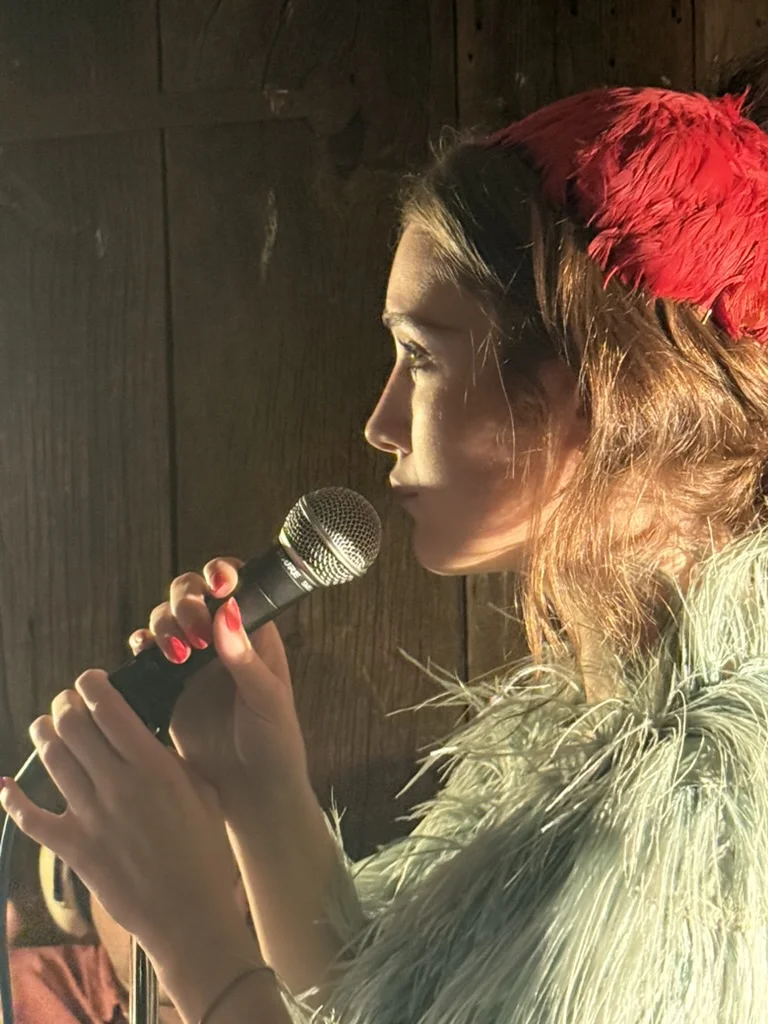
Talia Ryder, photographed by Andrew Norman Wilson.
Creative scenes, from KGB to Rome
The conversation keeps returning to the social places where people make things together. Bilandic had recently DJed a hotdog-eating contest organized by David Cardoza for ushers and ticket takers at New York repertory theaters. The winner, from Spectacle, ate 10 hotdogs in 10 minutes. The event reminded Bilandic of a talent night the pair used to put on at Rocco’s in SoHo, when bringing a crowd together could be as simple as giving them a stage and a reason to stay.
Ferrara said he had a bar in Rome with a similar setup, where bands perform and events can take shape. One group he found puts on David Lynch homage shows, playing the scores and bringing out a singer dressed as a Lynch character to perform “Blue Velvet.” Bilandic recognized the connection to the fun-house idea they had just discussed. The appeal is less about a polished replica than the pleasure of seeing familiar references reassembled in a live room.
For Ferrara, these modest venues sit in sharp contrast with the scale of a Saint Laurent show he attended after returning from Paris, where his book had come out. He described the lavish arrangements around the fashion event and the stark difference between the resources spent on a short runway presentation and the limited support available for a book. Francis Coppola was seated nearby, while K-pop stars drew much of the attention. Bilandic said the spending on fashion shows was hard to fathom.
Ferrara’s account is pointed, but the contrast also echoes the film’s interest in performance. A runway show can gather immense production resources around a brief spectacle; a neighborhood stage can build an audience through regular presence and a close relationship with its performers. Neither format is small in cultural effect just because it occupies a different scale. Bilandic’s suggestion that filmmakers could put Blu-rays into luxury shopping bags was a joke about distribution, but it also came from a real question: how might the resources circling one kind of event help another reach people?

Photo by Andrew Norman Wilson.
Ferrara spoke about the gulf between the attention and material comforts attached to the fashion event and the modest means surrounding a book launch. His wider point was about who gets access to culture and what cities choose to make room for. Bilandic answered with a New York example: people without homes in fashionable neighborhoods can become familiar local figures, watched and discussed as the city changes around them. The exchange gives their talk about films and venues a more grounded edge. Creative life takes place in cities shaped by unequal access to space, money, and attention.
Ferrara’s own life had shifted in ways he hadn’t anticipated. He was living in Rome with family responsibilities, including school and swimming lessons for his stepdaughter. Bilandic reflected that getting older had brought realities he never expected. Ferrara connected those feelings to the sharp divide he saw between people with enormous wealth and people without stable shelter. Neither tried to tidy the thought into a reassuring ending; the conversation stays with the strangeness of watching a city and a life change around you.
Fashion offered a lighter route back into the present. Ferrara asked Bilandic about New York in October, which he called the city’s creative time. In Italy, he said, October is known as “Cashmere Month,” when people bring the fabric back into rotation. Bilandic agreed that New York was at peak cashmere. It’s a quick style note, but it suits the conversation: seasonal dressing becomes a way of reading a city’s mood, just as a familiar bar or street can become part of a film’s visual language.

Owen Kline, photographed by Louis Miller.
Back at KGB, Bilandic said, the group had been meeting for 15 years. The crowd had changed, with a new generation of people gathering there, but the core pleasure remained: working with close friends and returning to a place where people could watch things together. He described that continuity as a privilege and hoped the group could grow. Ferrara laughed at the idea that such an enterprise might provide a living. Bilandic conceded that it was a wild ambition.
That closing exchange feels like a compact description of the film’s world. Bilandic draws on repeat collaborators, trusted rooms, and the open-ended energy of a live performance, while staying clear-eyed about how hard it is to make a creative life pay. Cabaret Boys turns those realities into a setting for Jackman’s peculiar belief in other people’s artistic potential. Its cabaret may be fictional, but the method behind it is tangible: find the room, bring in people who know how to play, and let the work retain a little of the life happening around it.

Michael M. Bilandic, photographed by David Cardoza.

Shane Fleming and Miles Emanuel, photographed by Louis Miller.

Abel Ferrara, photographed by Stephanie LaCava.

Sean Bentley and Michael M. Bilandic, photographed by Louis Miller.

Owen Kline, photographed by Louis Miller.