Bassam Tariq’s New Film Finds Fatherhood, Faith and Humor in a Samurai Story
In Your Mother Your Mother Your Mother, Bassam Tariq pairs a hitman’s double life with the daily work of fatherhood, using humor, action and intimate collaboration.
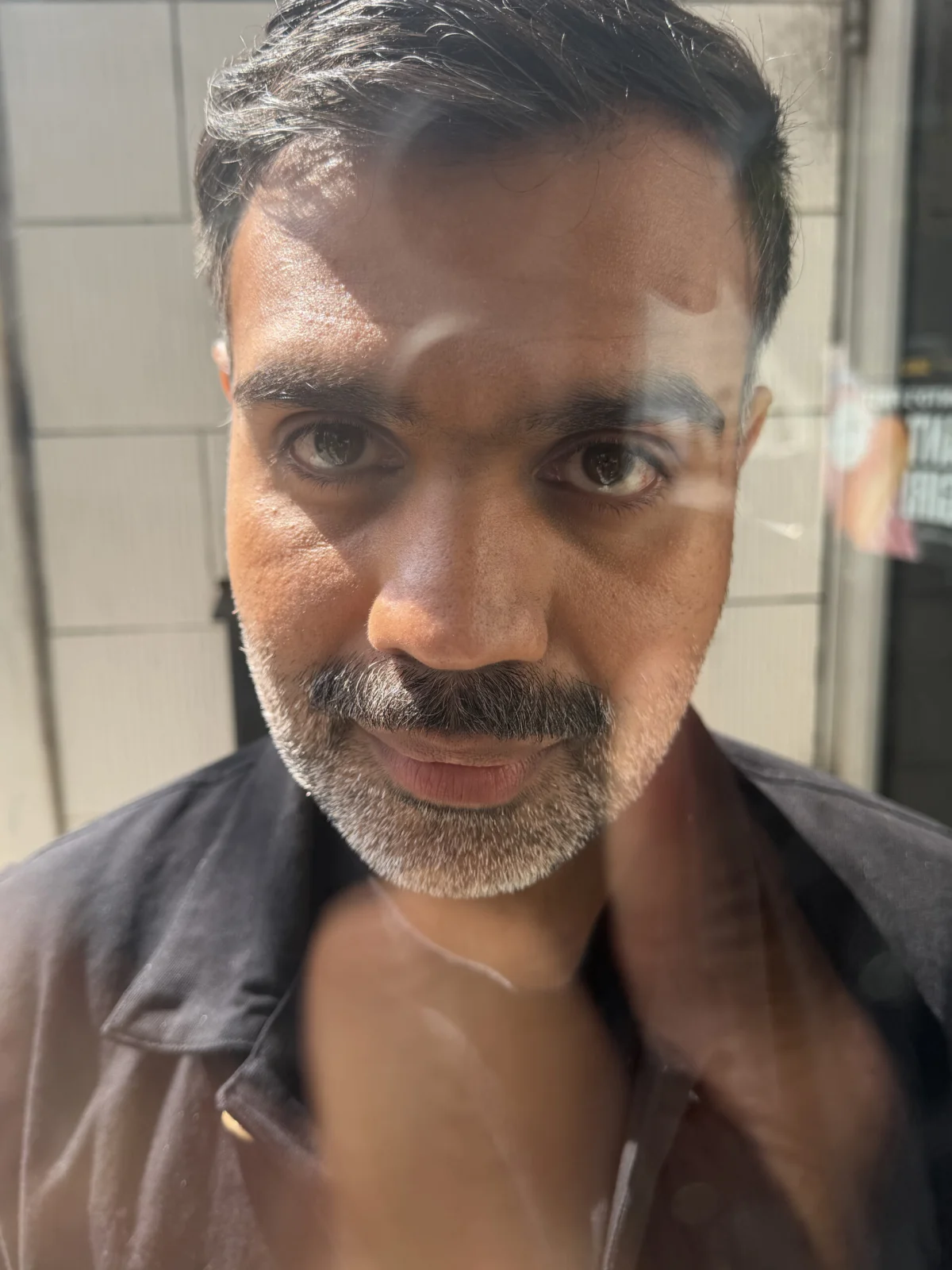

All photos courtesy of Myles Pettengill.
Bassam Tariq’s Your Mother Your Mother Your Mother puts a father’s private life and professional violence on a collision course. Mahershala Ali plays a devout Muslim who is a part-time hitman and the full-time father of three. When his wife dies suddenly, he must care for their children, including a newborn daughter, while trying to hold on to his faith and keep working. The setup carries the shape of a genre film, but Tariq is drawn to a more intimate question: what parts of yourself have to fall away before you can be present for the people who need you?
The film, which Tariq wrote and directed, grew out of his own changing sense of identity and his experience of fatherhood. He describes that process as a recurring kind of ego death: the gradual loss of ideas about who he ought to be. His conversation with longtime friend and collaborator Riz Ahmed ranges from the film’s humor and visual influences to the uneasy balance between a director’s conviction and openness. Their exchange offers a portrait of a filmmaker who has come to see creative work, family life and even routine chores as connected forms of attention.
TUESDAY 1:45 PM SEPTEMBER 29, 2026 HOUSTON
A film with its own rhythm
For Tariq, making this film has been cathartic. Its reception has also clarified something about where his voice belongs. After once imagining that he needed to leave the United States and move to London, he now recognizes himself as an American filmmaker. One reason is the comedy: audiences have laughed more than he expected, and he suspects his humor plays more naturally in the United States than it might in the United Kingdom.
Ahmed points out that humor has always been part of Tariq’s approach. When they worked together on Bait, Ahmed says, Tariq brought jokes and flair to the material, and their trust in each other made room for ambitious choices. That trust mattered because the collaboration had other people and studio structures around it. Tariq worried that the pressures of the work could damage their friendship. Instead, he learned that collaborators who care about each other can work inside a demanding system if they establish a shared code of conduct.
That experience gave Tariq the confidence to approach Ali with an invitation to build the new film together. Their developing shorthand helped them reach the story’s more difficult ideas. Tariq also valued the fact that Ali’s character is a Black Muslim man. With that perspective at the center, he felt less pressure to pause and explain every point of cultural context. The creative energy could go toward making those ideas more complex and pushing the film further.

The movie’s mix of Houston, comedy, intense action and emotional intimacy made its first audience response hard for Tariq to predict. At the Toronto International Film Festival premiere, he worried viewers might not know what to make of it. He remembered the response to Mogul Mowgli, which many people understood but which also drew dismissive remarks suggesting it was only for South Asian audiences. This time, he hoped to make something accessible without sanding away its particular character.
Ali’s presence brought its own expectations. People began comparing the project to a Muslim version of Blade or John Wick, but Tariq and Ahmed agree it has to stand on its own. The comparisons created pressure around how much action the film needed and whether audiences would accept the ending’s large creative swing. Ahmed cautions Tariq not to reveal that ending, then asks whether the uncertainty has eased. Tariq says it has: people are finding their way into the film.
Fatherhood changes the terms
Fatherhood is not a theme Tariq arrived at from a distance. His children are 12 and nine, old enough to form preferences and ask for space. He has begun to understand that a child’s affection cannot simply be assumed. A young child may follow a parent’s lead without much debate; an older one can choose to be elsewhere. For Tariq, that shift means learning when to give his children room rather than deciding in advance how their time together should look.
That recognition has made him examine the rougher parts of his own character. The film’s father reaches a point where his actions raise a hard question: after a parent has shown a frightening side, can the relationship recover? Tariq’s answer is rooted in persistence and imperfection. Children may keep loving a parent, he believes, but that love does not remove the need to keep showing up in a broken, human way. He also sees a reversal in the usual idea of parental care: children can be the ones who help repair their parents.
Ahmed describes Tariq’s humility as a rare strength in a director. A filmmaker needs enough certainty to keep pursuing a vision, he says, and enough openness to listen to collaborators and respond to the story. Tariq, though, wonders whether he sometimes gives too much ground or struggles to hear his own instincts. Ahmed frames conviction and surrender as two necessary forces. One says the work should follow your will; the other asks you to serve something beyond your ego. Without both, he suggests, a director can lose direction.
That tension sits at the center of the film. Someone described it to Ahmed as a samurai story about killing the ego, an idea he found beautiful. Tariq says he once doubted he would make films again. He wanted to shape a samurai film around the versions of a man that must die for him to become the father his children need. To him, filmmaking itself can demand a similar shedding: a person enters with fixed ideas and has to surrender some of them as the work unfolds.
Mogul Mowgli had already taught him that lesson. Tariq recalls arriving with a self-righteous certainty that he knew what he was doing, then being challenged repeatedly. Ahmed’s compassion during that process made a lasting impression. Their collaboration included arguments and blunt recognition that each could be difficult, but also laughter, tears and embraces. Tariq remembers the experience as a generous one, full of room to change.

The pair joke about the discomfort of looking back at who they were. Tariq cites a saying about needing to feel embarrassed by your past self if you are growing. Ahmed asks whether being embarrassed by who he was the day before counts. The humor lands because their conversation treats self-criticism as an ongoing practice rather than a grand transformation. Ego, in this account, does not disappear once. It keeps returning in new forms, each one asking to be noticed.
Tariq connects that process to parenting. A parent can carry an image of the person a child should become, but the child will have a character and direction of their own. Tariq wants to meet that person with curiosity and awe. When a child feels judged against a parent’s expectations, he says, the judgment can become a belief that they are not enough or that their parent does not love them. Children need approval, and giving it requires a parent to pay attention to who they actually are.
He finds this harder at home than on a film set. Tariq says he can be more generous toward cast and crew than toward his own family, a difference he is trying to understand. Ahmed brings up a thought from Ethan Hawke: ordinary life can feel scratchy and difficult, while creative work can offer a smoother place to escape. Tariq agrees, adding that professional relationships have a structure personal relationships do not. People on a production are being paid to be there and have a practical reason to make the work succeed. A partner or child has no such obligation to remain close.
Ahmed sees a useful lesson in the care collaborators bring to a project. After becoming a father, he began to question the idea that everyday life exists mainly to support his work. He now wants to bring the patience, grace and cooperation he has learned at work back into his life. Perhaps, he suggests, a creative practice can train someone for daily relationships as much as daily experience feeds the art.
Finding the sacred in ordinary work
Tariq says marital counseling has helped him become a better director. Working with actors and crew involves intimate communication, and he has brought Gottman tools into those relationships. Ahmed recognizes that as part of a larger effort to connect the person Tariq is at work with the person he is at home. The film makes that split vivid: its protagonist is a single father in one part of his life and a hitman in another.
Ahmed recalls Tariq once saying that making a love letter to home can be easier than actually being there. The phrase captures the push and pull between home’s acceptance and the way family can see through a person’s evasions. Tariq agrees that people often divide themselves into separate compartments, but he has started to see how those compartments eventually collide. Keeping work and home distinct may help for a time; treating them as unrelated can become unsustainable.
He also links that question to artificial intelligence, which has prompted him to ask what human work means and what people are here to do. For Tariq, the answer begins with making a process feel sacred. Ahmed describes friction as the thing that gives creative work meaning. Tariq takes the idea beyond filmmaking: he wants to value the labor he has been fortunate enough to do, even the domestic tasks he dislikes. Washing dishes and doing laundry can become ways of finding significance in the banal.

That attention to the ordinary also shapes the film’s visual language. Tariq and his collaborators looked to Jim Jarmusch’s Ghost Dog: The Way of the Samurai, as well as classic samurai cinema. He singles out Harakiri for its composed, stately style and the way it builds toward a striking final fight. The reference points help frame the film’s action: violence can carry weight and form, but the surrounding quiet and daily routines matter just as much.
Making room for an actor’s process
Tariq calls working with the actors the best part of the production. Ahmed’s performance, he tells him, was a masterclass, but Tariq’s directing method begins from the premise that each actor needs a different kind of conversation. Respecting that difference means making space for the performer’s process rather than offering a stream of instructions.
With Ali, the team held many read-throughs. Ali knew the character intimately, and rehearsals gave the actors room to ask one another questions and find ways to improve the material together. Tariq often directs performers toward the body, pointing to the stomach as a place where a performance can begin. Ahmed remembers being told to put the feeling there. The instruction is brief, but its purpose is clear: let the scene come from physical understanding, not just an explanation of what the character thinks.
Tariq has also learned to say less. He dislikes receiving too much direction himself, so he wanted actors to have room to experiment, take risks and discover choices. With Ali, that meant balancing availability with privacy. Ali has not often led films, Tariq says, and has developed ways of preparing that do not depend on frequent conversation with a director. At first, he wanted substantial time alone. Tariq made clear that his door was open, then let trust build at a pace that suited Ali.
The process differed from Tariq’s work with Ahmed, who might check in with him in the morning and again in the afternoon. Ali needed more space. Ahmed compares the distinction to parenting: each child needs something different, and noticing that difference is part of the work. He returns to the idea that children can rescue their parents, a thought that echoes the film’s emotional core.

By the end of their conversation, Ahmed hears in Tariq’s account the same quality he sees in the film: an effort to bring openness and nuance into relationships at home and on set. The story’s unusual combination of fatherhood, faith, action and comedy depends on that willingness to let different elements sit together without forcing them into familiar categories. For Tariq, the work is less about holding every part of himself in place than paying attention to what each relationship asks of him. The film’s lasting question may be simple: what can a person lay down, and what must he keep showing up for?