Romain Gavras and Robert Pattinson on Sacrifice, Cinematic Chaos and Making Style Matter
The director and actor unpack Sacrifice’s darkly comic premise, its Greek locations and the visual choices that make screen chaos feel alive.
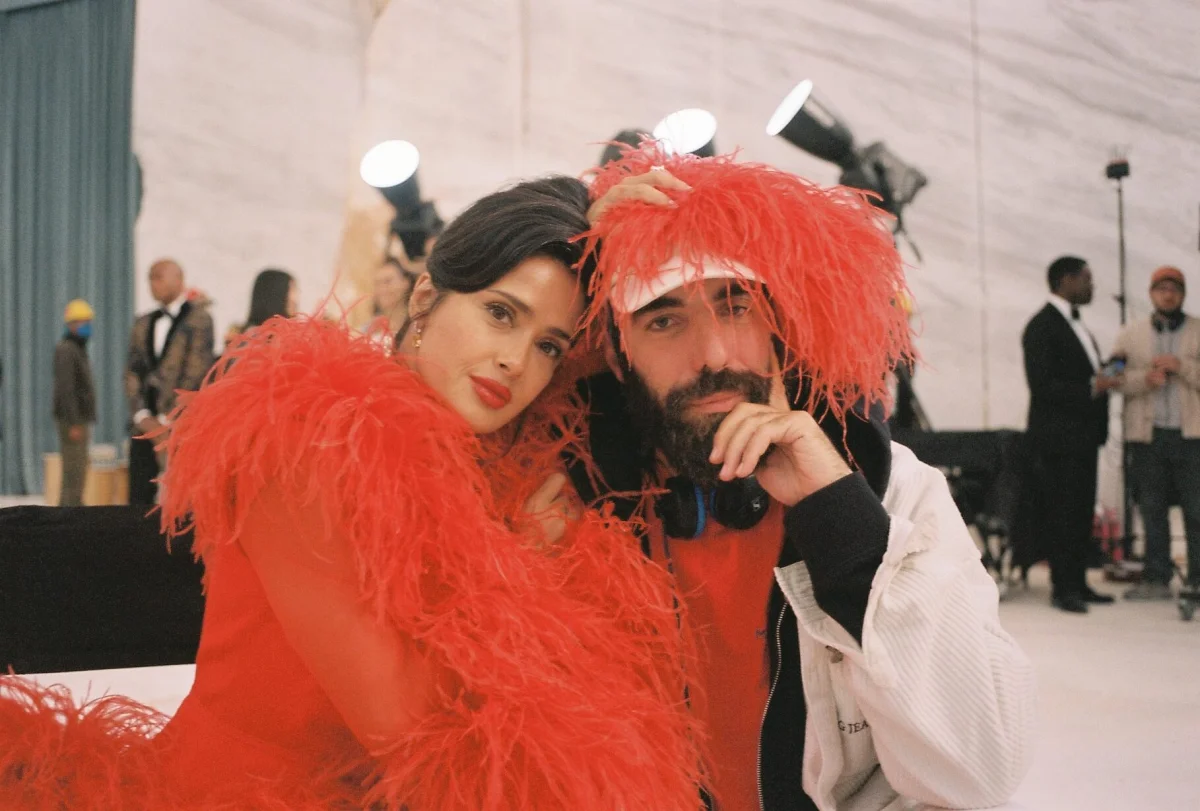

Salma Hayek Pinault and Director Romain Gavras on the set of Sacrifice. Courtesy of Kim Chapiron/Netflix 2026.
Romain Gavras’s Sacrifice starts with a proposition so outrageous it doubles as a joke: perhaps the rich and famous should be thrown into a volcano to save the world. The French director’s new film turns that provocation into a dark comedy about a charity gala, a remote Greek quarry and a group of ecoterrorists who take their guests hostage. Anya Taylor-Joy, Chris Evans, Vincent Cassel and Yung Lean star; the plan involves selecting three people for the volcano.
That premise could easily collapse into a one-note provocation. Gavras and his friend Robert Pattinson, who spoke with him about the film, see its possibilities in the friction between absurdity and conviction. Their conversation ranged from the movie’s visual approach and its unusual locations to actorly instinct, horror audiences, memes and deodorant. The through line is Gavras’s interest in images that can hold several moods at once: funny, violent, beautiful and unsettling.
A volcano, a gala and an intentionally absurd idea
Gavras says the starting point came from mischievous thoughts he had at film festivals. Among the polished events and displays of wealth, he imagined someone arriving to announce that the festivities were over. His Greek upbringing, steeped in myths and volcanoes, supplied the next turn: what if the intruders didn’t have a conventional plan, but wanted to send people into a volcano?
He brought the idea to writer Will Arbery. Gavras describes the early version as a rough 10 pages that the pair developed into the script, and says the collaboration grew into a close friendship. Comedy was part of the concept from the beginning. For Gavras, the premise is too silly to play straight, while its setting and stakes give it room to become something darker.
That tonal mix is central to the film’s pitch. Gavras wants life’s unevenness on screen: laughter beside menace, beauty beside violence. He even jokes that the volcano plan might be a solution to the world’s problems, after attempts at communism and capitalism. Pattinson counters with the familiar idea that personal change must come first. Gavras calls the thought corny, but says he believes it; the pair land on Michael Jackson’s “Man in the Mirror” as a fitting soundtrack for the sentiment.
The film’s satire sits within a familiar eat-the-rich tradition, but the volcanic scheme pushes the conceit toward myth and farce. That shift matters. Instead of grounding the story in a realistic political argument, Gavras leans into an image that is both ridiculous and spectacular. The volcano becomes a blunt, almost theatrical answer to the inequalities on display at the gala.

Courtesy of Kim Chapiron/Netflix 2026.
Style is part of the storytelling
Pattinson describes a hunger for directors with a distinctive visual approach. He recalls growing up fascinated by Luc Besson and says that a strong sense of style feels less common to him now. Gavras rejects the old debate about style versus substance: cinema makes images, he argues, so style belongs to the form itself. For him, the camera’s choices aren’t decoration layered over the story; they are part of how the story is told.
Pattinson says he often finds a director’s camera movement more useful than a verbal explanation of a character’s psychology. Seeing how the camera travels can give him a direct sense of the scene’s physical shape and help him understand what performance is being asked of him. He points to the camera grammar of filmmakers such as Steven Spielberg and Martin Scorsese as a formative reference.
Gavras compares directing actors to a dance. He says each performer responds differently to the camera, and that he can anticipate moments when Cassel is especially effective in close-up. Pattinson agrees that proximity can be unpredictable: sometimes a camera only inches away makes a performance feel impossible; at other times, a nearly still performance can read as doing nothing. He praises Cassel’s ability to move from relaxed joking to intensity without making the shift feel labored.

Sacrifice. (L-R) Chris Evans and Sam Richardson on the set of Sacrifice. Cr. Kim Chapiron/Netflix 2026.
The production’s Greek locations helped shape that physical approach. Gavras says the film was shot in Greece and Bulgaria, using demanding settings that included a marble quarry, a river and a volcano. He prefers working with the actual environment where possible. Difficult locations can give performers something tangible to respond to, he says, and reduce reliance on green screen.
Pattinson offers a useful counterpoint from The Lighthouse, where Robert Eggers’s production design made the set feel concrete and creatively energizing. Yet he also likes the control of performing toward a tennis ball when a scene calls for it. The trick, they suggest, is not that every scene needs a real location; it’s that actors and directors need a clear imaginative framework, whether the scene is built around a fully realized set or a simple stand-in.
Gavras typically avoids storyboarding because he can’t draw and feels a storyboard can lock him into a narrow frame. He still plans carefully. For a crowd scene, he might rehearse with one group of people while another group waits to film a single take. That setup lets some performers encounter the scene without knowing exactly how it will unfold. Their unprepared reactions add a charge that a perfectly rehearsed sequence might lose.

Sacrifice. Anya Taylor-Joy on the set of Sacrifice. Cr. Kim Chapiron/Netflix 2026.
This balance of structure and surprise also informs his camera choices. Gavras often shoots with one camera, though he adjusts when a scene involves several actors. A single camera makes him commit to the shot rather than assuming the edit will find its shape later. He wants the disorder to register in front of the lens, with the camera’s framing doing the work of guiding the audience through it.
Pattinson connects the method to Athena, Gavras’s earlier film, which he says builds an immersive experience without calling attention to the fact that it’s trying to immerse the viewer. For him, an audience can feel the action more strongly when the filmmaking doesn’t keep announcing its own intensity. Gavras agrees that chaos needs direction: without a considered frame, it can turn indistinct.
A cast built around different kinds of presence
Sacrifice is Gavras’s first large ensemble featuring American actors, including Evans and Taylor-Joy. He says the independent production put the cast in a shared frame of mind, even while filming in challenging locations. The group’s different performance styles became part of the movie’s texture rather than something to smooth away.
Yung Lean, whose given name is Jonatan Leandoer, was the first actor cast. Gavras asked him to play a young man in love with his sister. The musician had appeared in music videos but had little experience with blocking. Gavras encouraged him to let that awkwardness show, since the character has little understanding of the world around him. He saw in Leandoer a poetic, endearingly clumsy quality, along with a strong inner life that came through on camera.
Pattinson remembers seeing Leandoer perform when he was around 15 and noticing his charisma. Gavras says the camera doesn’t require much from him: his presence and inner world carry the shot. That confidence sits alongside a deliberately uncertain physicality, giving the character room to feel both watchable and inexperienced.
Evans presented a different challenge. Pattinson says the role is funny and asks whether audiences might mistake the character’s views for the actor’s own. Gavras praises Evans for making a character who could simply come across as unpleasant unexpectedly likable. That charm complicates the satire: viewers can be drawn to a person even while questioning what the character represents.

Sacrifice. (L-R) Anya Taylor-Joy and Vincent Cassel on the set of Sacrifice. Cr. Kim Chapiron/Netflix 2026.
The costumes offer another route into character and setting. Gavras says the clothing for Taylor-Joy’s group references 1990s Bosnian soldiers, with the story’s mountains and snow informing the choice. It’s a specific visual reference tied to the physical world of the film, rather than a generic uniform for a band of insurgents.
Music was part of the writing process as well as the finished film. Gavras and Arbery shared a playlist while developing the script, using songs to establish a feeling for particular scenes. Yung Lean’s “Agony” was part of that early emotional palette. An Arthur Russell song arrived later, despite being one of Gavras’s favorites. The two selections reflect the way the film’s sound can join its carefully planned imagery to a more elusive mood.

Courtesy of Kim Chapiron/Netflix 2026.
Chaos, audiences and the images that stay with us
Pattinson asks whether making destruction beautiful risks making viewers want more of it. Gavras answers through the image of a phoenix: chaos can contain the possibility of rebuilding. He sees excitement and positivity within disorder, not because damage is harmless, but because cinema can show the energy of change through it.
His answer connects to the film’s visual strategy. If a scene’s disorder is carefully composed, the audience can feel both its danger and its formal beauty. Gavras’s preference for a single camera helps him hold onto that balance. The image has to make the chaos legible as it happens, rather than relying on the edit to manufacture intensity afterward.
The interview also circles back to how audiences carry film beyond the cinema. Gavras says he sees memes of Pattinson from his different roles on social media. Pattinson finds that strange and admits that it can affect his thinking as an actor: he may wonder whether a particular delivery could become a meme. The pair compare that impulse to the way people once repeated memorable lines from films. Pattinson suggests that memes have taken on some of that function.
For a director raised on late-night MTV, images and music have long been linked. Gavras recalls seeing Aphex Twin’s “Windowlicker” and Daft Punk’s “Around the World” when he was young, and describes the experience as bewildering. He also says MTV shaped his 1990s childhood. The conversation offers a small clue to his visual appetite: images can unsettle before they explain themselves.
When Pattinson asks which recent film made Gavras jealous as a director, Gavras names Weapons. He saw it with his daughter in a packed cinema and was struck by how the crowd reacted, shifting between screams and laughter. Though he doesn’t consider himself a horror-film enthusiast, he admired the film’s command of its audience. Pattinson, a horror fan, describes the genre as a communal thrill, like a rollercoaster ride: the audience knows it has come for a particular kind of experience and gets to share the response.
Gavras’s film education wasn’t always so immediate. His father introduced him to Andrei Tarkovsky and Ingmar Bergman very young. He watched Stalker at about seven and found it unbearable; Bergman seemed boring. Revisiting both filmmakers in his twenties changed his view. He says adulthood let him recognize their subtlety. The anecdote makes a quiet case for returning to art at a different stage of life: the viewer changes, and so does the work.

Chris Evans on the set of Sacrifice. Cr. Kim Chapiron/Netflix © 2026.
Work in progress, and an ending with a little hope
Neither filmmaker offers a firm next-step plan. Pattinson says he’s finishing Batman and looking forward to a vacation. He describes acting as an exhausting cycle: he can pour his energy into a few months of filming, then step away, though he often finds himself preparing for another project at the same time. Gavras is writing and developing music videos, keeping a few ideas in motion until one becomes the most exciting.
They recognize the peculiar lifespan of creative work. Pattinson jokes about projects that have been pitched for 12 years and half-finished songs sitting in old voice memos, including one from 2013. Gavras compares the approach to looking up at a mountain before starting the climb. The metaphor is playful, but it captures a real part of filmmaking: a project can feel enormous before the crew ever reaches the set.
Gavras says he always knew how Sacrifice would end, but declines to spoil it. He calls the ending hopeful and says he believes in grand gestures, adding that the film leaves open the possibility that one might work. That conviction suits a story built on an absurdly large act. The movie’s images may be chaotic, but its final note, as Gavras describes it, points toward possibility.
One last detail from their conversation is less epic: Gavras found that an online search for Pattinson led to an old reputation for not wearing deodorant. Pattinson says he does now, after paranoia sent him toward especially strong chemical products. Gavras, who says he doesn’t wear deodorant himself, had assumed they shared a habit. The exchange is a fitting opening to a conversation that travels from grooming trivia to Greek myth, from movie-star memes to the craft of controlling a frame.
At its most interesting, Sacrifice seems to embrace that same leap in tone. It can take a ridiculous premise seriously enough to build a world around it, then leave room for the joke, the beauty and the uncertainty to coexist. For Gavras, the work is in making those elements visible without sanding away their edges.

John Malkovich on the set of Sacrifice. Cr. Kim Chapiron/Netflix 2026.

Courtesy of Kim Chapiron/Netflix 2026.
The post Romain Gavras and Robert Pattinson Are Ready for the End of the World appeared first on Interview Magazine.